Showing posts with label Central Philippines. Show all posts

Tuesday, May 8, 2012

Boracay

Taking in the northern part of the Visayas and Palawan, this is a sprawling area of scattered islands, many of them home to stunning white beaches and offshores coral reefs, including Boracay and El Nido, two of the country's most popular resort areas, The region also host some spectacular annual festivals, most notably Dinagyang held each of January in the city of Iloilo.

Iloilo is both one of the Visaya's most important cities and a historic place, a site colonized by the spanish in the very early days of their takeover of the Philippines. The surrounding areas bears some of the marks of the colonial presence, mainly in the form of fortress-like churches, the most famous being a World Heritage Site located in the town of Miagao.


Right: An afternoon view of the northern end of Boracay's magnificent White Beach. Stretching along much of the Island's west coast. White beach is lined for almost its whole length with reataurants, bars, hotels and the ubiquitous coconut palm.


Boracay
The Philippines' most popular tourist attraction, Boracay is a tiny island, barely 8 Km. long, lying off the southern tip of Panay, one fo the Visayas' main landmasses. Discovered as a holiday paradise in the 1980s by backpacking travellers, the draw has always been its credible White Beach that stretches 5 Km. along the west coasts. While those early backpackers might have found only very basic accommodation, today Boracay boasts some world-class resort hotels and is very much a mainstream tourism destination. Though it might be difficult to find solitude on White Beach these days, the sand remains stunningly white and fine, and the sea azure and crystal clear.


Above left: A sailing  outrigger, or 'paraw', sits on the shore at the southern end of White Beach awaiting customers, Paraw's are widely available for hire on Boracay, for peaceful wind-driven tours around the island, free from the typical clatter of a 'banca' engine!


Above right: The northern end of White Beach, Boracay. Sun-loungers. parasols, swaying coconut palms, fine white coral sand and a gently lapping azure sea; what more could one ask for from the archetypal tropical beach retreat?


Above: A long much of its length. White Beach is backed by a sandy traffic-free path lined by hundreds of shops, restaurants, bars and hotels, plus a liberal scattering of souvenir and snack stalls, all catering to a wide-ranging international clientele.


Above left: Built of thatch and coconut timber, Nigi Nigi Nu Noos is a long stablished restaurant in the centre of White Beach. These traditional materials were standard on Boracay few years ago, ensuring that the development blended in well with the rural setting, though this is increasingly giving way to concrete.


Above right: At Puka Beach close to Boracay's northern tip. a souvenir stall displays wind chimes made from shaped and painted sea shells.

Iloilo and its Surroundings

Iloilo may not initially appear to be the most obvious of places to visit, but it is nevertheless worth exploring for a number of reasons. Each January Iloilo hosts what is undoubtedly one of the Philippines' most spectacular festivals, during which the city's street are filled with dance troupes competing in hugely colourful and elaborately choreographed performances.
Outside festival season, the surrounding area is worth eploring for its string of historic Spanish-era churches, most specially that at miagao, a World Heritage site that is protected for its wonderful facade.
For those who like wandering on beaches. although long stretches of golden sand and tuquoise water are hard to find, here these are replaced by busy, friendly, fishing communities, where you can watch the catch being brought ashore, along with boats being repaired, launched an returned.

Above: The Jaro district of Iloilo City is Well known for ceramic jars, which can be bought in Belfry Plaza, dominated by the Spanish-era Belfry, as shown in this dusk shot.

Left: Miagao Church is one of the Philippines most famous man-made landmarks between 1787 snf 1797, it is a world Heritage Site due to its stunning exterior depicting St Christoper in a tropical garden.


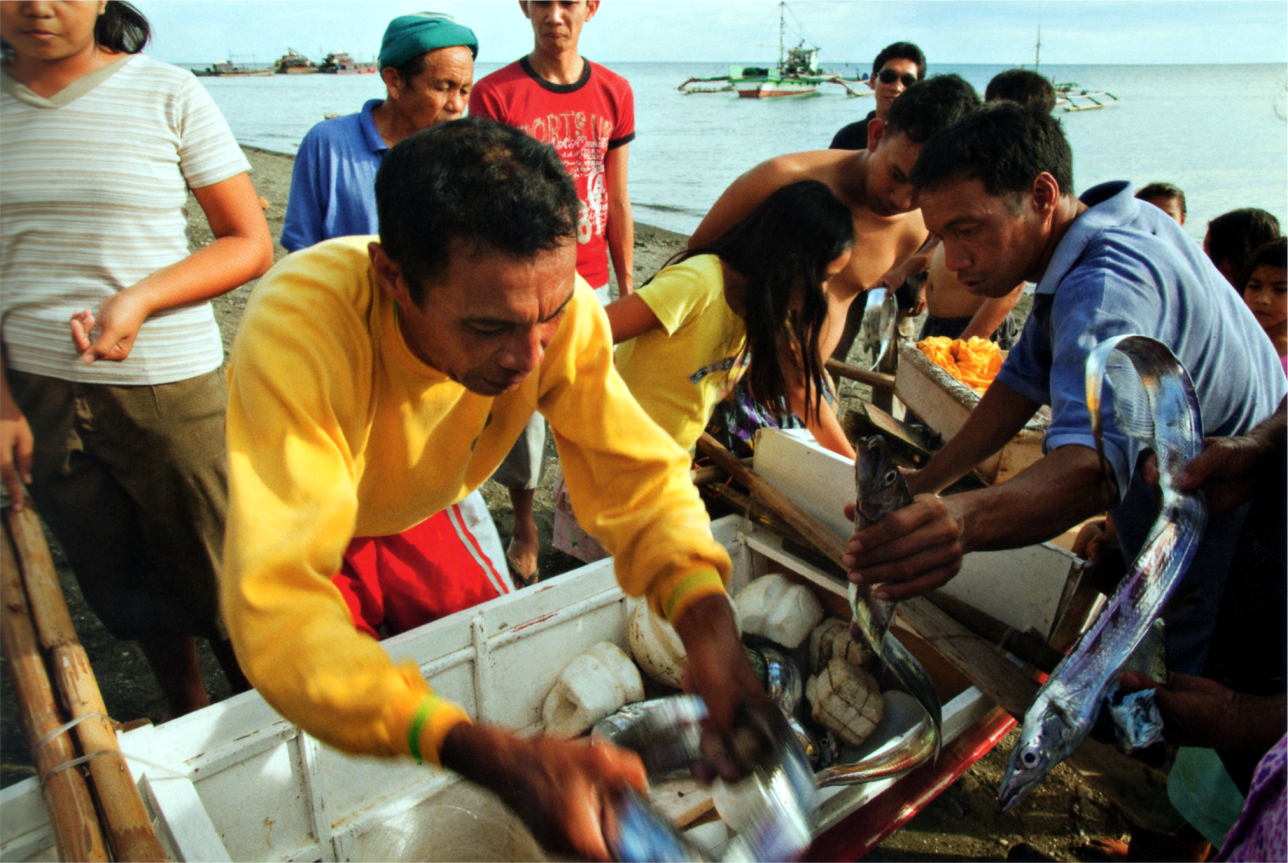
Above: Having just returned from a fishing trip and pulled their boat up onto the beach at Miagao, fishermen sort through the catch in preparation for selling it to friends and neighbours gathering arround.

Left: The Iloilo is renowned in the Philippines fot its high  quality weaving, including cloth produced on the handlooms of Indag-an Cooperative in Miag-ao, shown here.


Dinagyang Festival: In a country renowned for its festivals, Iloilo's Dinagyang is arguably one of the Philippines' most spectacular. Held annually over the third weekend of January, events kick off on the Friday evening with a huge food festival. Hundreds of food stalls setting up on the streets, One of the most popular dishes is grilled satay (far right). The saturday is dominated by the kasadyahan dance competition, taking place in several grandstand set up on Iloilo's streets, Amateur dance group from local colleges and villages get to strut their stuff, with huge, lavishly choreographed performances that aim to celebrate such aspects of local life as fishing (above right) or agriculture (left). Outside the grandstands, the crouded streets are lined with stalls selling snacks and mementoes (above right),


The main event of the Dinagyang Festival is Ati-Atihan, held on the Sunday. It commemorates land deals agreed between the native Aeta tribes and Malays immigrating from Borneo in the 12th and 13th centuries, allowing the Malays to settle in Panay. Consisting of a dance competition held in grandstand set up on Iloilo's streets enormous amateur dance groups stage stunningly elaborate performances, complete the blackened skin and hugely spectacular tribal-style costumes that aim to recall the beneficent Aeta tribes.

El Nido - Palawan

A remote location on Palawan's northern coast, El Nido is arguably one of the Philippines' most beautiful areas. Named after the town that is the area's one and only hub. El Nido consists of an archipelago of small islands scattered across sheltered Bacuit Bay. The bays landscapes is formed largely of almost sheer karst limestones cliffs similar to those seen in the wonderful mountain peaks of southwest China or southern Thailand, some plunging hundreds of metres straight into the sea. Among these cliffs are scattered occasional golden sandy beaches, each usually backed by a small clusters of coconut palms and reachable only by boat. it is hard to imagine anywhere better for those wanting to really escape the rat race and play at being Robinson Crusoe for a while.

Below: The coast around El Nido is characterized by enormous limestone cliffs, the less steep parts covered with dense rainforests.


Below left: This particularly spectacular karst limestone pinnacle and cliffs stands guard over the approach to Lagen Island, one of many rocky islands in El Nido's Bacuit Bay.

Below right: At dusk the stunning outlines of the  limesone rocks and cliffs in Bacuit Bay. as seen here on Lagen Island. Become really  apparent, while  the soft colours give a sense of calm and peace.


Above: One of the great attractions of beautiful Bacuit Bay is the number of beaches that lie in many of the small coves, allmost accessible only day boat. Shown here is Seven Commandoes Beach quite close to El Nido town.


Above: A street scene in El Nido town. with motor tricycles, the local taxi, and signs in Spanish (the guesthouse), English (American names on the tricycles), and native Pilipino (Advertising in the shop).


Left: On El Nido town's central plaza, a pleasant space outside local government buildings, motor tricycles wait for passengers in the shades of a stunninglu beautiful tree


Above right: Using a bamboo pole to manoeuvre a Banca away from a beach in Bacuit Bay. The engines of many Philippine Bancas have no reverse gear, so backing away from the shore can be a tricky process


Below Right: El Nido's harbour consists of a huge, natural harbour, sorrounded by high cliffs and forested hills. Hundreds of boats sit on moorings, using the beach as their passenger and cargo pick-up and drop-off area.


Below: A dusk view of the beautiful Lagen Island Resort, showing some of it's bungalows, standing on stilts in the shallows of a protected cove, and backed by sheer limestone cliffs.


Below:  The bar and restaurant area of the exclusive Lagen Island Resort sits right besides the shore in sheltered cove on Lagen Island deep in Bacuit Bay.


Below:  Most visitors coming to stay at Lagen Island and Miniloc Island Resort arrive bye air, The resort have their own jeepney that shuttles their guests from the airport to the harbour for the boat ride out to the island.


Below: Coconut palms stand clear of rainforest and backed by sheer cliffs on Lagen Island. While many of Bacuit Bay's islands are forested, on Lagen Island the presence of a resort has greatly improved that island's forest protection.