Showing posts with label A Pacific Rim Archipelago. Show all posts

Saturday, May 12, 2012

A Pacific Rim Archipelago

Dreams of a tropical island escape inevitable conjure up visitor up vision of blinding white sands lined by swaying palm tress, perhaps framed by a backdrop of rugged  cloud-capped mountains, the sand lapped by a crystal-clear azure sea. Beneath the water's perfectly white-tipped waves lie spectacularly colourful coral reefs populated by shoals of iridescent fish of all shapes and sizes, an occasional frisson of excitement thrown into an otherwise blissfully relaxing scene by the shadow of a passing shark.

Such dreams could easily serve as a description of the Philippines. or at least significant numbers of its 7,000 plus island. Admittedly, to describe the whole of this island nation as a tropical paradise would be an exaggeration, but so many of its sandy, palm-lined beaches and islands match seem like a dream come true. Couple this with an unwaveringly enthusiastic and friendly welcome from the locals and it is easy to see how the Philippines rates as one of the world's great tropical island getaways. Not that the Philippines is about only beaches, coral reefs and sparkling seas, of course, Inland rise some of Southeast Asia's most rugged mountain range, many of them volcanic, some still cloaked in dense tropical rainforest. They are home to a huge diversity of plant and animal wildlife seen nowhere else on Earth. It is for good reason that scientist have classified the Philippines as one of the  world's nine priceless biodiversity hotspots. Diversity continues at the human level, though initially the country can appear to be ethnically rather uniform. However, this superficial impression masks a diverse and widespread range of peoples, particularly in the remote mountainous region of the north, among the Muslim groups of the far south and across some of the island groups. It adds up to a great human variety that lends an extra dimension of fascination to an already to an already beautiful and vibrant country.


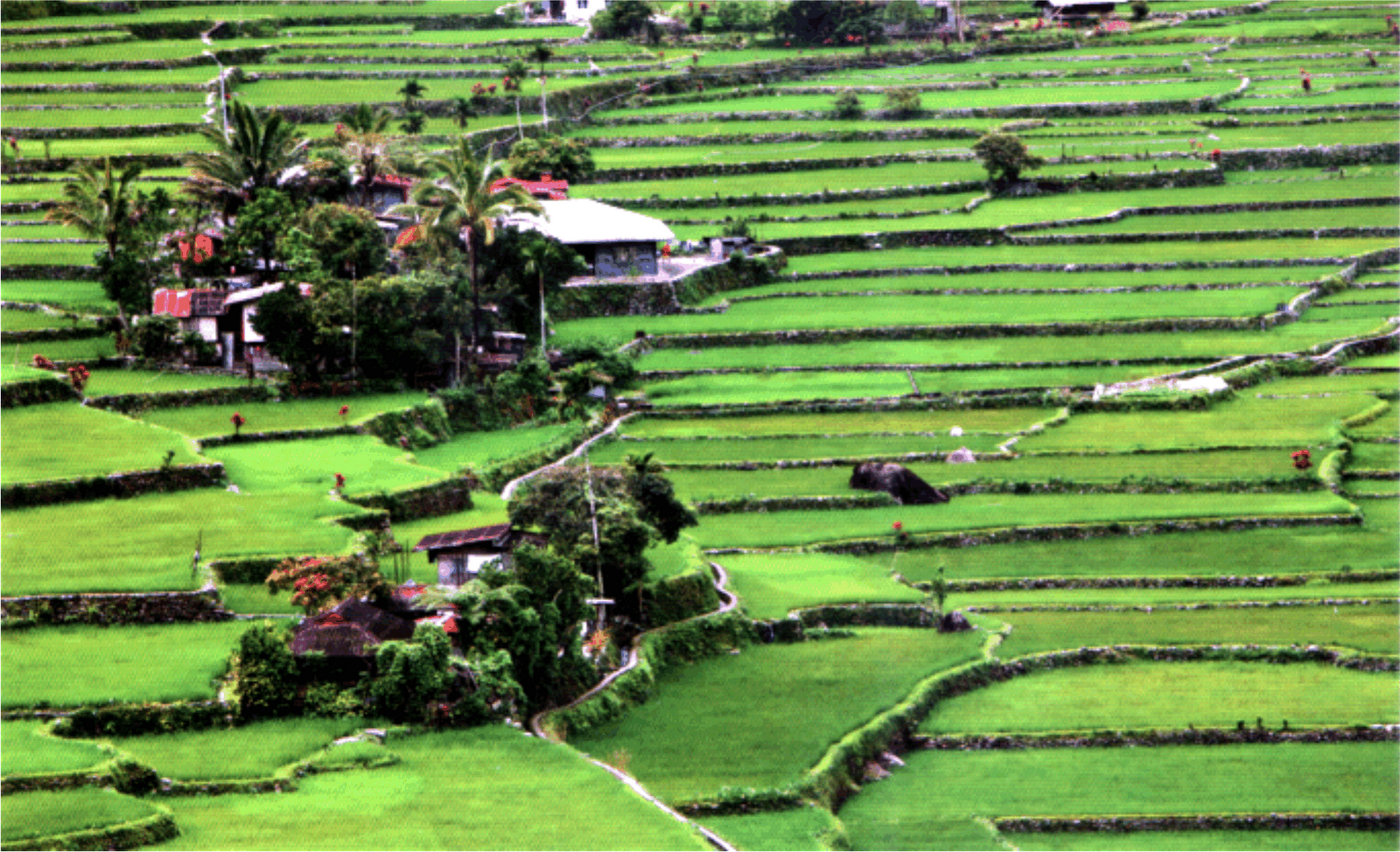
Top: Typically rugged mountains of northern Luzon. partly cloaked in forest, partly turned over to agriculture, cut into steep rice terraces.


Above: The stunning Seven Commandoes Beach is typical of the many sandy bays, accessible only by boat, scattered around the island of El Nido, in northern Palawan.


Right: A Milithaea species sea fan thriving on one of the Philippines' many coral reefs, this one is the remote Tubbataha Reef, off the coast of Palawan.

A Philippine Volcanic and Seismic Landscape

An Alternative name for the pacific Rim is the Ring of Fire since the entire island chain from Kamchatka down to Indonesia is highly volcanic, with many hundreds of volcanoes dotting the landscape, 22 of them presently known to be active, The Philippines is a fully paid-up member of this club, Much of the landscape is characterized by these volcanoes, their slopes sweeping up in graceful curves, gently at first but then ever steeper towards the summit, towering ominously above the surrounding countryside or coast. Arguably the most spectacular of these is Mount Mayon, an almost perfect 'textbook, conical volcano looming above the city of Legazpi in southern Luzon. Unfortunately, it is also the liveliest, experiencing regular, but relatively small eruptions every few years. The biggest and deadliest eruption in recent times, however, was that Pinatubo in northern Luzon which exploded with devstating effect in 1991 after lying dormant for over 400 years. Fortunately, however, most of the time the volcanoes simply lend a dramatic, and often stunningly beautiful, aspect to the landscape. They are natural features to be admired and explored, although they should always also be treated with respect and some caution. All this volcanism is closely linked to the immense seismic activity that rumbles under the Philippines, which is the result of huge tectonic forces at work in the Earth's crust. The country sits on its own relatively small tectonic plate, Which is gradually being crushed between the very much larger Eurasian and Australasian plates, steadily pushing the island ever upwards. The result is a characteristically mountains landscape criss-crossed by fault lines and pockmarked with volcanoes. The highest peaks reach nearly 3,000 m, the tallest of them being Mount Apo at 2,956 m an inactive volcano in southern Mindanao.

Top: The shattered and flooded crater of Mount Pinatuboseen over a decade after its massive 1991 eruption.

Below: Mount Mayon, the Philippines' most active volcano, towers threateningly above the city of Legazpi, in southern Luzon


Left: Ardent Hot Spring, a popular bathing spot on  the slopes of Mount Hibok-Hibok, an active volcano on Camiguin Island, off the north coasts of Mindanao is one the benign gifts of a volcanic landscape.

Below: Seen from the rim of Taal caldera, the little Taal Volcano sitting on an island in Lake Taal, looks quite innocuous. In fact, it is one of the Philippines most dangerous volacanoes.


Top: A gigantic tree surrounded by bamboo, growing in lowland rainforest in Subic Bay, Northern Luzon.

Below: The instantly recognizable  Pompadour Green-Pigeon, Treron pompodora , is a quite common resident of many Philippines forest, particularly at the forest edges.


Top right: The Philippine Tarsier 'Tarsius syrichta'. at 8 cm long is one the world's smallest primates, Its is unique to Bohol and Mindanao but is related to a Tarsier in Borneo.

Below right: A young Philippine Dear, Russa Mariana , species spread thinly across much of the Phlippines.

Below left: This tangle of vegetation in dense rainforest, in El Nido Palawan, is typical of the Philippines natural vegetation, as it would be across much of the country were in not for human activity


Above: A typical rural scene, a stream flowing through verdant forest as it drops down out of the mountains interior. Seen on the slopes of Mount Hibok-Hibok, on Camiguin Island, Mindanao.

Friday, May 11, 2012

A Unique Natural Environment

Having been driven up from the ocean floor by tectonic movement, most of the Philippine islands have never formed part of any of the world's major landmasses. As a result, a significant proportion of the Philippines' plant and animals wildlife has evolved in glorious isolation, resulting in an immense diversity of species found nowhere else. Only Palawan is an exception to this rule, a land bridge having once joined it to Borneo, giving it a fuana and flora related to this part of Southeast Asia. Even within the Philippines, the various island groups have remained isolated from each other for so long that different, though related, species have evolved in each.

The Philippine Eagle is the king of the
Philippines rain forest. At over 1m tall
and with a wingspan of 2 m, it is one
of the worlds largest eagle.
Life In the Forest
As a wholly tropical country, tropical rain forest is the natural vegetation for pretty well the entire country, even at high altitude, and it is likely that at one time almost the whole of the Philippines was forested. Not surprisingy, the vast majority of the country's 12,000-plus plant species (including nearly 4,000 species of native tree) make up this environment, while the bulk of its animal wildlife is adapted to life in the Philippines rainforest.
Over 600 species of birds have been found in the Philippines, the great majority living in the forests, more than 190 of them unique to the country. Many are quite small and difficult to spot among the vegetation, but the largest and most spectacular is the magnificent Philippine Eagle, standing over 1m tall and with a wingspan of over 2 m making its world's second largest eagle.
And even higher proportion of the less mobile animal species are endemic. Three-quarters of the 190-plus species of mammal, for instance, are unique to the Philippines. Only one of the well known primates typically found across.


Left: The long-tailed or crab eating Macaque, 'Macaca Fasciculars', is widely found in Philippine rainforests and is one of the few large mammals to have made the lump from mainland Asia to the Philippine island.

Below: Huge Fruit-bats here seen roosting in a tree in rainforest in Subic Bay, northern Luzon, commonly live in mixed species colonies, they are widespread in Philippine lowland forests.

Southeast Asia is found in the Philippines and that is the Crab-eating or long-tailed macaque, which is frequently seen in forest across much of the country. Another primate that, though endemic, is related to one found in Borneo is the Philippine Tarsier. This tiny, cute animal, with a body bare 8cm long and a tail nearl twice that, is restricted to forests in Bohol and Mindanao. The largest of the Philippines' endemic mammals is undoubtedly the Tamaraw, a shy dwarf buffalo found only on mindoro, By contrast, the great majority of the country's mammals are quite small and inconspicuous. There are, for instance, many types of cloud rats, a rodent that exists as a number of species with very limited ranges in specific parts of the country. About 20 per cent of all the country's mammals are bats, ranging from tiny, hard-to-see insect eaters up to enormous fruit-eating species with the wingspans of almost 2 m. They are frequently seen in roosting as large colonies in their favourite rainforest trees.

Life in the Sea
Things couldn't be more different in the sea. Dive near any healthy coral reef and you are immediately surrounded by a cornucopia of animal life, not just the corals themselves, of course, but also a huge range of fish species. These creatures are not restricted to the Philippines as many of the land animals are: all the marine life found here is distributed across much of the Indo-Pacific region, from the tiniest coral species to the  largest shark or whale. Indeed, with 500-plus species of corals found in Philippine, Indonesian and Malaysian waters, this region maybe the primary source of the corals found across much of the indian and Pacific Oceans. Mobile marine life is no less diverse, the nooks and crannies of a reef providing a home for a great range of invertebrates, such as shripms, crabs, lobsters and squid, while the surrounding waters are filled with an enormous stock of fish ranging from tiny, brightly colored clownfish up to tuna, sharks and the occasional manta ray.

Above: Sea fans are corals commonly found in the deeper water reefs, particularly on steeps walls where currents are strong. This one is a 'Melithaea' species, seen on Tubbataha Reef, off the coast of Palawan.


Left: A typical seen  on the crest of a coral reef, showing a dense mixture of different species of hard and sort corals. Seen on Tubbataha Reef, off the Coast of Palawan.

Fishermen, such as those seen here on Camiguin Island
Mindanao, have been finding it increasingly difficult to
catch enough fish to support themselves
Threats and Conservation
A replanted and steadily recovering mangrove swamp
in Subic Bay, Luzon, point to increasing efforts
to restore the Philippines' environment
Commercial exploitation and a burgeoning human population have taken a heavy toll on the Philippines' natural environment. Forest cover is probably little more than 10 per cent of what is 100 years ago and much of what survives is badly damaged. This loss of habitat has put not only a large number of endemic plants on the endangered species lists but also many forest-living animals. Foremost among these is the mighty Philippine Eagle, now Probably restricted to just a few hundreds survivors in the wild,  scattered across Mindanao and northeast Luzon, plus the islands of  Samar and Leyte.
The Philippines developed one of Southeast Asia's first Protected areas systems, established by the American colonial government during the early years of the 20th century, but after independence, gained in 1946, this initiative was largely ignored. Many supposedly protected areas where heavily logged and then settled by farmers. From the late 1980s onward, plans were set in motion to rescue the situation, a number of international funded and organized programmes being set up, aimed at rejuvenating the protected areas system  and safeguarding the best and  largest of the remaining wild areas. 
A number of home-grown environmental conservation movements also gained momentum, principally the Haribon Foundation of the Philippine. The latter took upon itself the task of saving the Philippine Eagle, initiating the first attempts at captive breeding, as well as undertaking conservations work in Mindanao's forest. For some time captive breeding proved to be almost impossible, but in recent years there has been considerable success and PEF is now engaged in experimental releases of captively bred eagles back into the wild. As on land, the marine environment is also in trouble. Most reefs are seriously damaged by over-fishing pollution and the indiscriminate use of dynamites. However, conservation measure are now having an impact. Reefs that have been long-protected either as tourist diving or university research sites continue in good health, while regeneration is starting to take place at those environments included in protected areas programmes. Instigation in the 1990s of small, highly localized marine reserves especially aimed at protecting reefs to boost fish stocks initially met stiff resistance from local fishermen. However, so successful were they in achieving their goals that fishing communities right across the country are now increasingly organizing their own reserves.

The People

The Philippines' almost 100 million people must be among the friendliest on the face of this Earth, never shy to welcome visitors, always ready with a smile. Despite the difficult conditions that many Filipinos live under, there seems to be an almost universally positive outlook on life, something that even some Filipinos - let alone foreigners- find difficult to fathom, they certainly have a great capacity to live in and enjoy the moment, without worrying about what the future will bring. It is undoubtedly true that the strenght of their extended families contributes hugely to a sense of personal security and belonging.
They also know how to party. Celebrations of all kinds figure large in Filipino life, Providing regular opportunities to break off from the hard graft of daily toil. Every community,  from the largest city to the smallest village, or barangay, has at least one annual fiesta to celebrate perhaps the harvest, an important historical event or a local patron saint,


Above:  The Philippines is a densely populated country, making the cities' streets often rather crowded, though almost always colourful and lively

Filipino teenagers everywhere, wanting to be cool and
fashionable. Here some are seen hanging out at a
beachsidecafe in Miagao, near Iloilo.

providing regular opportunities for everyone to let their hair down. Some fiestas have become huge events with nationwide frame, the most important including Ati-Atihan in Kalinbo, Dinagyang in Iloilo and Sinulog in Cebu City.  Unlike many Asian Countries, women figure large in the Philippines' public life, taking a wide range of prominent roles from managing small family-run businesses up to position in local and national government. It is no coincidence that the Philippines has has two female president in the pas 25 years, Corazon Aquino and Gloria Macapagal-Arroyo. The origin of this female equality is rather unclear, but there is evidence that it is buried deep in Philippine history, reaching back to matriarchal practices predating the 16th - century arrival of the Spanish.

Below right: A Festival Musicians complete with homemade drums, take moment to relax between performances

Below Left: Vast Numbers of Vibrant, Colourful festivals are held across the country, one of the most famous being Iloilos's Dinagyang Festival, held each January.


It is generally believed that most Filipinos are descendant mainly from Austronesian people who arrived about 5,000 years ago from their homeland in Taiwan and Southern China. Over this settlement has been laid a more modern input from Malay peoples arriving from the Indonesian island on an number of occasion over the past 1,000 years. Those human migration have created a patchwork of ethnic and cultural diversity, with about 90 per cent of Filipinos conforming to the mixed Austronesian-Malay description, often known locally as Pinoy. The remaining 10 per cent consist of quite mixture of peoples ranging from those who are much more strongly Malay, generally living in the far south, to those with little or no Malay ancestry and so boasting almost pure Austronesian heritage. These people live mainly in the north, Either in remote islands such as Batanes, or high in northern Luzon's Sierra Madre and Cordillera Central Mountain ranges.
The plethora of cultural minority groups include such peoples as the Ifugao and Igorot in Luzon's mountains, the Ivatan in the Batanes Island, or the T'boli, Badjao, Monobo and Yakan living in Mindanao and the Sulo Island of the far south. In addition to all these groups there is one more, known by variety of names, most commonly Negrito, Aeta, Ati or Agta. Often considered the Philippines' aboriginals, the Aeta too are thought to be immigrants, though ones who arrive about 20,000 years ago. Still living a largely hunter-gatherer existence in the country's forests, their numbers are in decline, at least in part due to the shrinking forest environment that sustains their lifestyle.


Above: The Ifugao are one of the most well known of the Philippines' minorities living in northern Luzon's mountains, particularly around the town of Banaue. These days they rarely wear traditional clothing, seen here, generally reserving it for festivals and certain tourist locations.

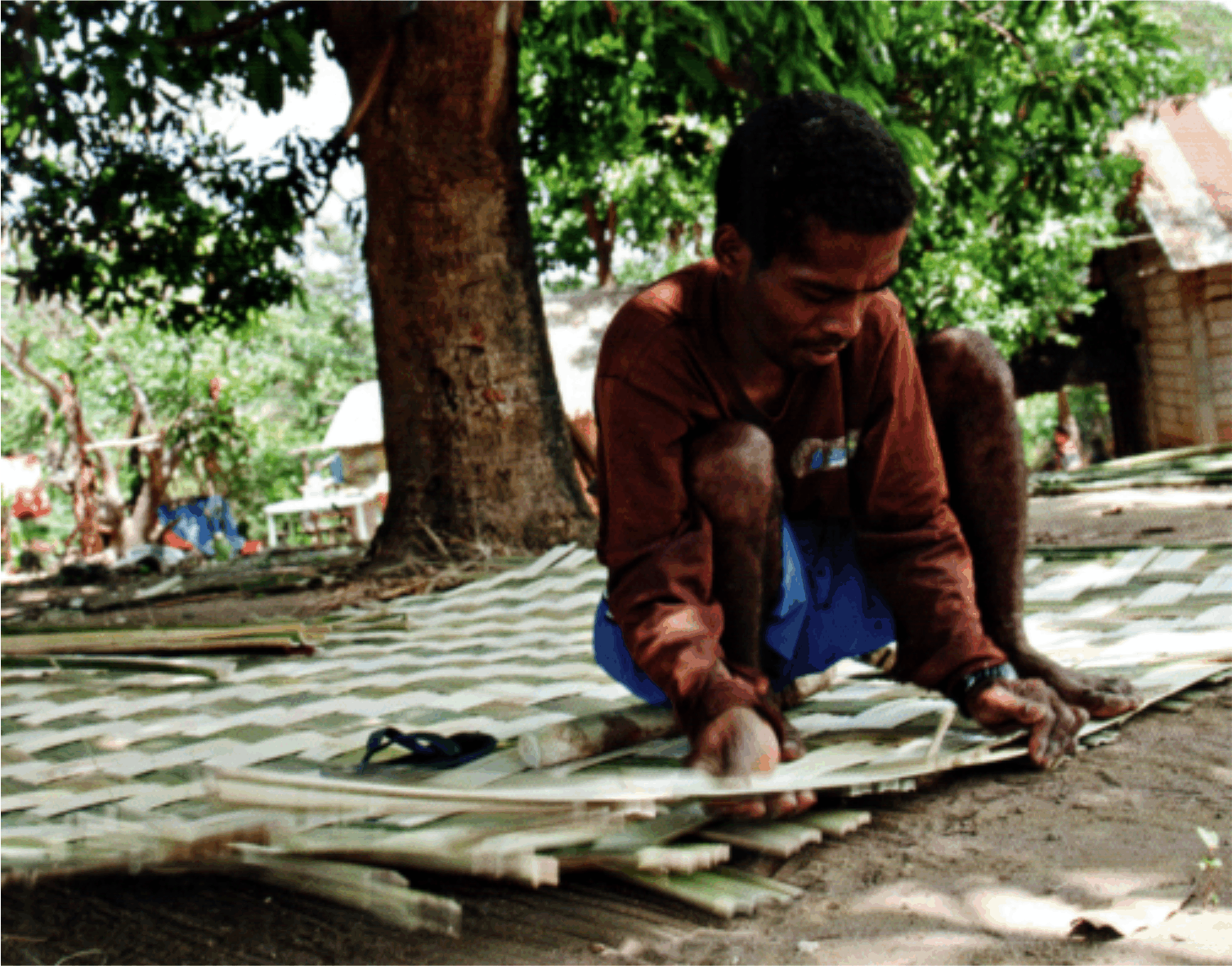
Below left: An Aeta man seen building a bamboo wall at a forest village near Subic Bay, northern Luzon.


A Tagbanua fisherman,with
one of this granddaughters,
sits mending his fishing net in
the village of Cabugao, on
Coron Island Palawan.


Right below: A Mangyan man cutting open a coconut, in the forests of  Mount Malasimba, near Puerto Galera, northern Mindoro.

Evidence of this cultural and ethnic diversity is found in the huge range of languages spoken across the country estimated to be as many as 100. Most are used by the cultural minority groups, with just eight languages shared across the main Filipino population. Of these, two dominate: Tagalog and Cebuano, the former the language of northwestern Luzon, particularly around Metro Manila, and the latter prevalent across the Visayas. English has been grafted onto this as a lingua franca. It is always surprisingly that, After 350 years of rule by Spain, the Spanish languages is not more widespread. in fact, fragments of it are frequently heard in two main ways: firstly as words and expressions that have become integrated into the Filipino languages and secondly as names, both of places and of people.


The in which foreign influences are readily absorbed by Philippine Culture is one the country's great wonders. It seems that few are ever completely rejected; most are sbsorbed, spun around a few times, slotted in all among the customs and then expressed in daily life with a uniquely Filipino Slant. Perhaps the most dramatic is the fervent devotion of the Filipino population to catholicism. One of only two Christian countries in Asia, over 80 per cent of the population is Catholic, most regularly attending mass, with about another 10 per cent adhering to other Christian denominations. Not surprisingly, Catholicism has left a very visible mark upon the landscape in the form of now quite ancient and historic spanish churches, fortress-like building dotted across the country. Most of the Philippines' festivals have a strongly Catholic slant, including processions devoted to local or national saints, particularly the Santo Niño, a very popular nationwide theme.


Above: The interior of the Basilica Minore del Santo Niño, a church that is much more important to the Cebuano people than the newer Cebu Cathedral. The 18th century basilica houses a statue of Christ as a child, brought to the Philippines by Ferdinand Magellan
Left: The facade of Cebu Metropolitan Cathedral, dating from the 19th century, is typical of Spanish colonial architecture, marking both the dominance of Spain and Catholicism in the Philippines


Above: Residents of remote island in the Siargao Island, demonstrate their religious devotion by bringing their icons to be blessed at the cathedral in General Luna, Sirgao's main town.


Left: Even the most riotous festival usually has a serious religious element, often the presentaion of Santo Niño statues, as seen here at Dinagyang festival, in Iloilo.

About half of the remaining 10 percent of the population is Muslim, living mostly in the south of Mindanao and Palawan, as well as in the Sulu Islands. Almost all of these Muslims belong to one or another of the region's cultural minority groups, though far from all of the minorities here are Muslim. Known collectively as Lumad, the Mindanao-based non-muslim cultural minorities are either Christian or animist in their beliefs. This is also true for most of the cultural minorities living across other parts of the Philippines.

Philippine History

A statue in Metro Manila's
Makati district to Sultan Kudarat
celebrate the 17th-century Islamic
leader who resisted the Spanish
invasion of southern Mindanao.
Today, one of Mindanao's 
province is named after him.
There was a time when many accounts of the Philippine history began in 1521, the year in which the spanish first arrived under the command of Portuguese adventurer Ferdinand Magellan, Needles to say, however the indigenous Filipino people had been living here for quire some time before the Europeans showed up in the years since independence there has been a steady piecing together of what life was like in the pre-hispanic centuries.

Although the earlier records of human settlement go back about 50,000 years to remain found in caves in southern Palawan, in the main influx of people into the island of the Philippines occurred about 5,000 years ago, when Austronesians migrated form southern China and Taiwan.

Below: Remnants of the pre-Hispanic tradition of living in scattered rural communities, or barangay, rather than towns can still be ween in the mountains of Northern Luzonn.


Below:  The Magellan Cross, set against a frescoed ceiling, marks the spot in Cebu City where Ferdinand Magellan planted the original cross in 1521, starting the Christianization of the Philippines.


For many centuries the Philippines island existed with no single central authority, much of the population living in scattered autonomous communities, or barangay. Major trade centres grew up on the coasts, linked to one o other of the successive Indianized empires that came and went along the coasts of Southeast Asia.
Chines records show that the most important of these trade centres became Cebu, Butuan and Tondo, that last of very close tot the site of modern Manila's prot, while the other two remains as important cities. Chines ships which dominated the seas of Southeast Asia at this time began trading with these ports at least as early as the 9th century.
From the 13th century onwards, Muslin missionaries began arriving in the southermost Philippine island. Islam Steadily spread northwards, the first Philippines Islamic sultanate being stablishe in southern Mindanao in the 15th century.
Ferdinand Magellan arrived in Cebu with Three Ships in April 1521, having crossed the pacific in search of an east west route to the Spice Island, in Today's Indonesia. He quickly set about converting the local cheir, Huabon, his wife and his followers to Christianity but came unstuck when he ran up against Lapu-Lapu, cheif of nearby Mactan Island. In the ensuing battle, Magellan was killed, and the rest of his crew were lucky to escape with their lives. Today Lapu-Lapu is hailed as the Philippines' first national hero.


Above: A statue in Cebu City of Miguel Lopez de Legazpi,
Founder of the first permanent Spanish settlement in the
Phlippnes
For several decades the Spanish made  little serious attempt to control the Philippines, but all that changed when Miguel de Lopez arrived in 1565. He took over Cebu and built for San Pedro - still seen today - before moving his base to more easily defended site at today's Iloilo, on the island of Panay, he then captured both Tondo and nearby Maynilad, the two together forming the nucleus for Manila , centered on the mouht of the Pasig River.
Spanish control  of the Philippines lasted for 350 years, until the end of the 19th century when mounting resistance, led by such national heroes as Jose Rizal and Emilio Aguinaldo, led to spanish departure. Unfortunately, it was replace by a new colonial power, the United States, By the 1930s, however, plans were in place to grant independence, though this suffered a blow with the Japanese attack on Pearl Harbor in Hawaii in 1941, followed quickly by their invasion of the Philippines. By the end of 1944, however, The americans were back, with General Douglas MacArthur at the head of a massive military force.
The Philippines finally gained independence in 1946, since wich the country has been a democratic republic run by a US-Style Congress headed by a powerful president. There has been one major hiatus in this period - that of the dictatorship of Ferdinand Marcos.. Elected in 1965, by 1972 he had declared martial law, holding onto power until 1986 when he was finally forced to flee by a mass uprising, the People Power Revolution. Since then, successive governments have struggled to  rebuild the shattered economy, and though quite successful, they have been dogged by endemic corruption. Periodic communist and Islamic insurgencies, mostly in the far south, took their toll too. especially in the 1980s when unrest became almost nationwide. Improving economic conditions, coupled with a series of treaties, including the creation of a Muslim  autonomous region in Mindanao, had greatly reduce the feeling of national discontent by the late 1990s. In recent years, however, there has been a modest resurgence, mainly form Islamist and the Communist New Peoples Army in remote areas of the far south. despite this, the great majority of the country is essentially peaceful and economically has managed to ride out the global recession reasonably well.


Top: The internal compound of Port San Pedro, in Cebu City the first permanent spanish building in the Philippines, built in 1565


Above left: Miagao Church near IloIlo is now a World Heritage Site Due to its spectacular facade.


Above right: The entrance into one of the heavily fortified bastions in the old walls surroundings Intramuros, the Original Spanish capital in Manila.


Right: The Rizal Monument, in Manila's Rizal Park, Memorializes Jose Rizal,  father of the Philippine nation, executed near here in 1896.

The Economy


Though the Philippine economy has been growing strongly in recent times, it remain one of the weaker Southeast Asian nations, a continuing legacy of the damage done during the corrupt Marcos years.. Wealth distribution is extremely uneven, the richest few per cent of the population controlling much of the economy, the poorest  taking on average earnings of about US $40 per month.
Industrialization programmes have had an impact in some areas but most factories remain concentrated around metro Manila and Cebu; rich deposit of copper, gold, silver, manganese and nickel bringing in a valuable foreign currency. Unfortunately the mines employ relatively few people. Services, including government and tourism, provide workfor over half the population, though again they are predominantly focused on the main cities.


Top: The rice harvest, happening at different times across the country, include spreading the grains out to dry before storing. 


Above: Manila's container port, seen at dusk, is one of the Philippines' main trade connections to the outside world.


Left: Across many rural areas rice farming is king, particularly in the steep terraced fields of mountainous northern Luzon.


 Right: Fishing, practised mainly as a subsistence activity, is crucial to many poor coastal communities, and is carried out mainly inshore and using a small outrigger boats equipped with small-meshed nets.

Below: Quiapo Market in the northern part of Manila, is a crowded and often frenetic scene of small-scale family-driven enterprise, with everything from mangoes to fortune-telling for sale.


Agricultural and fishing remain overwhelmingly the nation main  rural employment, shaping much of the inland and coastal landscape. These are Probably the aspect of the Philippine economy that are most visible to the visitor. Not surprisingly, rice predominates; more than four million hectares are devoted to the crop. Through the year alternating waves of emerald green of golden yellow billow across the landscape.

A similar amount of land is covered with coconut palms, an estimated 220 million of them covering coast and countryside with their characteristic green canopy. Their  output makes the Philippines one of the world biggest producers of coconut products. Other important crops include sugar cane, coffee ang pineapples, grown mostly on large commercial scale plantations. 
It remains a fact of life, however, that there just isn't enough 2 work available, a situation made worse by the rapidly growing population. Its present level of almost 100 million is increasing by nearly 2 per cent as a result, the last 25 years have seen a growing flood of Filipinos travelling abroad to work, Million are now employed crewing ships, putting up buildings, nursing the sick and elderly and acting as a domestic helps right around the globe. Their financial remittances from abroad have become essential to help support families left at home and they have become a major sector of the national economy, their financial contribution amounting now to a staggering US $11 billion annually.

Thursday, May 10, 2012

Visiting the Islands

With its many stunning white corals and beaches, the coast is undoubtedly the country's main draw, most espacially  in the Visayas and Palawan Regions. The pre-eminent attraction is Boracay, a tiny island barely 8km long, the appropriately name White Beach running more than half its length. Other well known beach resorts include Panglao Island, El Nido, Puerto Galera and San Fernando. Some of these are now becoming popular tourist destinations, but many stretches of untouched golden sand remain, beckoning the adventurous, particularly in the remoter parts of Palawan, and on some of the smaller islands off the coasts of Cebu and Mindanao.

Below: Outrigger boats as seen here in El Nido  Palawan, are widely used for inter-island travel and almost universal in local water-home tours.

The mountainous interior has been largely overlooked by tourism, with the exception of the Cordillera Central mountain of northern Luzon. Here the magnificent mountainside rice terraces, a World Heritage Site around the Village of Banaue that were first constructed around 2,000 years ago, are the main attraction. Those in search of cooler weather head for the heights of Baguio; at some 1,500 m above sea level it is the Philippines' only high-altitude city.


Below: The Philippines' number one attraction is undoubtedly Boracay Island. due almost entirely to its spectacularly White Beach several kilometers of white sand and stretching along much of the island's west coast.


Wildlife watching is still in its infancy in the Philippines, partly as a result of the rather secretive fores-bound nature of many of the animals that live there. However, whale and dolphin-watching as well as bird-watching, are increasingly well organize. Bird-watching trips to a variety of forests around the country are now quite common, particularly Subic Bay, Mount . Makiling and St. Paul's underground River Whale- and Dholpin-Watching are largely a preserve of the Visaya's, most particularly off the southern coast of Bohol and in the Tanon Straits between Negros and Cebu, close to the Southern Luzon town of Donsol For several months of the year it is possible to spot and go swimming with the Whale Shark, which congregate there in large numbers.


Above: In recent years accommodation in  many resorts has headed upmarket, as i llustrated by the dusk view of Discovery  Shores, one ofBoracay's  most exclusive resorts.

Adventure Sports

Above: A mountain guide stands on the 
summit of Mount Apo, the Philippines highest 
mountain , after leading hikers up from Lake Agco
at the roadhead.

For many years virtually the only well developed adventure sport for visitor was diving, but recently other leisure activities have started to be offered, including, surfing, kite boarding, mountain biking, sea angling and white water rafting.

The Philippines has some of the best dive sites in Asia, its protected reefs a magnificently chaotic jumble of corals, home to a wonderful diversity of brilliantly colourful fish. Every beach resort has well organized ddive operations, offering plenty of diving opportunities, including globally recognize training and qualification courses.
Still on the water, windsurfing and kit-surfing have started to take off, particularly along Bulabong Beach on the east shore of Boracay, At its best during the onshore winds of the northeast monsoon, Bulabong has become a major venue for international competitions.


Above : Kite-Surfers prepare for a day's action at Bulabong Beach, on the east shore of Boracay Island, the Philippines' premier windsurfing and kite-surfing venue

Below: A boatman steers his banca away from White Island, an increasingly popular sandy island off Camiguin Island, Mindanao.


A diver rises up a submarine cliff
towards the surface, at Tubbataha
Reef,  of the Coast of Palawan.
Further south, the Siargao Islands, off the northeast coast of Mindanao and exposed to the full swell of the Pacific Ocean, have beacom known as the Philippines' premier surfing hotspot. Discovered in the 1990s by Australian surfing scouts, Siargao is particularly renowned for the so-called Cloud Nine surf break. Sea angling is also growing in popularity here, taking advantage of the area's deep Pacific waters.
Mountain hiking is increasingly available and although it is possible to arrage your own hikes (always take a guide), specialist operators also regularly organized hikes up several of the country's volcanoes , including Mount Apo, the Philippines' highest peak.
Two of the great bonuses of doing anything in the Philippines are firstly the fact that the vast majority of the population speak good English, and secondly that Filipinos  are almost without exception wonderfully friendly, helpful and hospitable to visitors, making getting around both a joy and relatively easy. All visitors need are a little patience, a sense of humor and the enthusiasm to get stuck in and enjoy themselves!